The house
The house on Calle Cuna
A 15th-century building that once held the stables of a neighbouring palace, now a flamenco cultural centre with its own small theatre on Calle Cuna.
Book the Casa de la Memoria show ↗Where the centre began
The operator says that Casa de la Memoria began in early 1999 as a flamenco cultural centre in Seville. Its first home was on Calle Ximénez de Enciso, in the Barrio de Santa Cruz. At the end of 2012 it moved to its present address, Calle Cuna 6. The operator describes the project as a centre, a museum and a tablao, which explains why the building has gallery rooms as well as a show room. It also describes the work as a family project of cultural managers who have, since 1998, promoted the history of traditional flamenco and the folk traditions of Andalusia.
A 15th-century building
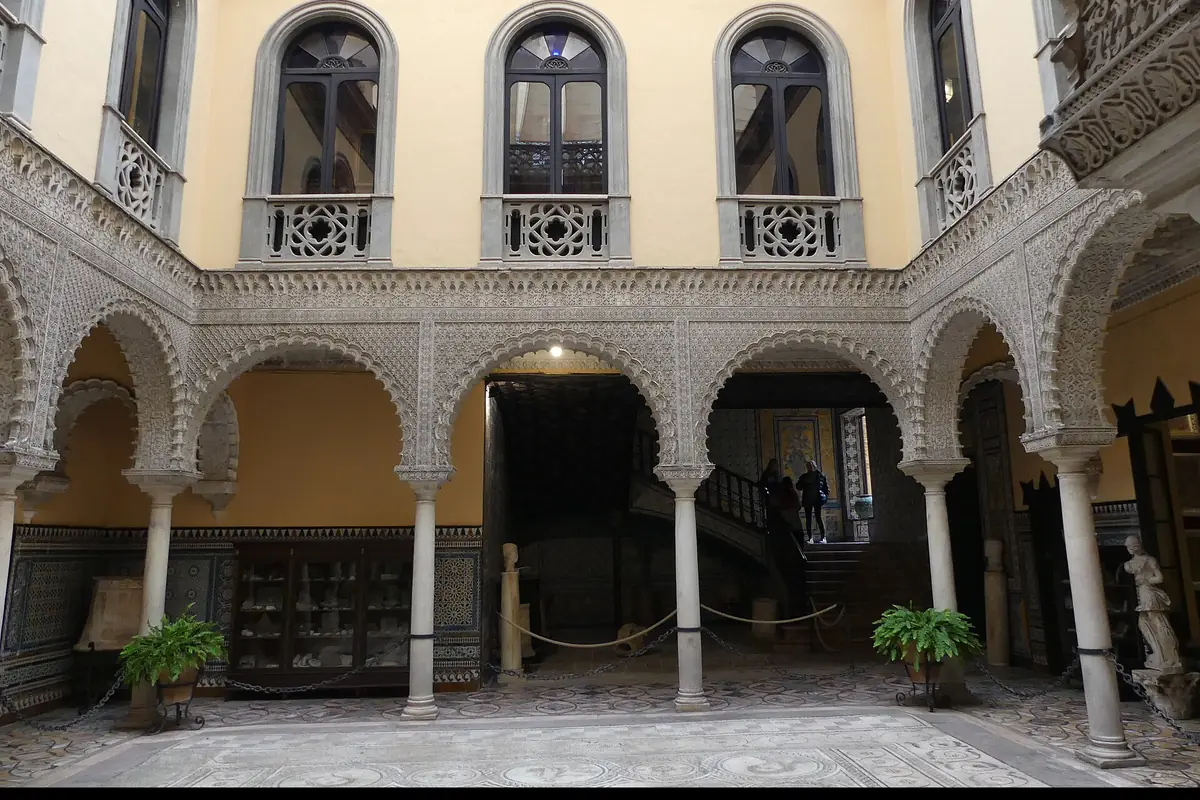
According to the operator, the building on Calle Cuna is historic and dates from the 15th century. It calls the building a house-palace that keeps the character of Sevillian tradition, with a central patio full of flowers and imposing walls of brick and stone. The centre has rooms for temporary exhibitions and for its own collection of art, objects and historical documents, alongside the theatre where the shows take place.
The stables of a palace
The operator states that the building once housed the old stables of the adjoining Palace of the Countess of Lebrija. That neighbour is a house museum in central Seville. Wikipedia says that its construction as a noble house began in the 15th century, that the facade was built in the 16th, and that the palace was remodelled between the 18th and 20th centuries. The two buildings share a history, even though they now serve different purposes.
The Countess and her mosaics
In 1901 the palace was bought by Regla Manjón Mergelina, Countess of Lebrija, who restored it to house her collection of antiquities. Wikipedia reports that Roman mosaics taken from the historical site of Italica pave almost the entire ground floor, and that a mosaic of the god Pan lies in the central courtyard. In 1999 the Countess's descendants opened the house to the public as a museum. If you want to see inside, check the museum's own opening times before you plan an evening around it.
A theatre shaped like a café cantante
The show room is described by the operator as a wide, semicircular theatre with a view of the central patio. Its shape recalls the old cafés cantantes, the singing cafés where professional flamenco was staged from the middle of the 19th century. The operator says that this layout lets the audience feel close to the artists and hear the sound without amplification. It is a small room, built for attention rather than for a large crowd.
Read next: From café cantante to tablao
Gallery rooms and other activities
The operator says the centre has several rooms for art exhibitions and a private collection. Over the years it also lists book and record launches, lectures, masterclasses on the history of flamenco, poetry recitals, guitar concerts and costumed visits among its activities. Whether any of these are open to you on a given day depends on the calendar, and your show ticket is a booking for the performance itself. Treat the gallery rooms as part of the setting rather than part of the booking, and look at the operator's calendar if you want to see what else is on.
Why the setting matters for the show
A show in a former stable, beside a palace patio, differs from one in a purpose-built hall. The brick and stone walls give the room a solid, close sound, and the operator stresses that the performers use no microphones. The result, in its words, is a real sound in an atmosphere that absorbs the viewer. The building does not promise a particular programme, but it does shape the way each programme is heard.
Sources